The Standard
The shape and dimensions of pipe fittings are regulated by standards.
- DIN = German Institute for Standardization
- EN = European standard
- ANSI = American National Standards Institute
The diameters of the flow openings are specified as nominal diameters (the inner diameter of the pipe).
For gas and water installations, the pipes and fittings should bear the DVGW letter sequence. This abbreviation stands for the German Technical and Scientific Association for Gas and Water (DVGW), which is the recognized standard setter for the gas and water industry.
The connection techniques
In earlier times, pipes were joined together by screwing, welding or soldering. This was very time-consuming and required not only a good eye when soldering or welding, but also sometimes a mirror to be able to see the weld or soldered seam at all. Today’s techniques, such as plugging, clamping, pressing and gluing, are not only faster, but can also be carried out in areas where there is a risk of fire.
Copper solder fittings
The copper solder fittings offered for capillary soldering are subject to DIN EN 1254 and can be found, if still present, on every finned radiator in old buildings.
Push-in fittings
The push-fit connections are used for wastewater pipes made of ceramic, concrete and HT and KG pipes. The abbreviation KG pipe stands for sewer base pipe. They are orange-brown in contrast to the gray HT pipe (high-temperature pipe). The HT pipe can withstand temperatures of up to 95 degrees. There is usually a rubber sealing ring in the groove. Greasing the rubber helps enormously when fitting together.
Press fittings
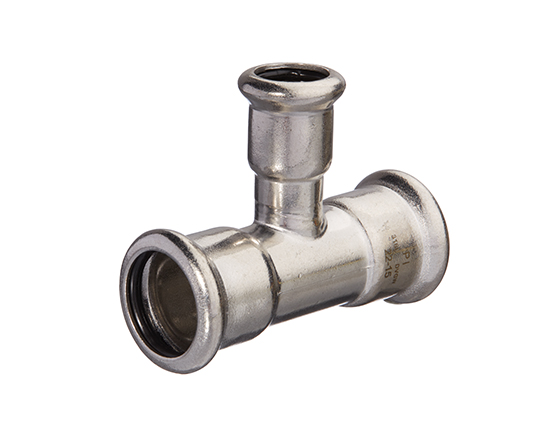
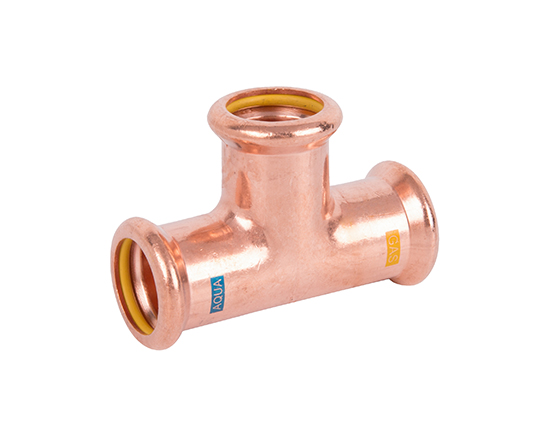
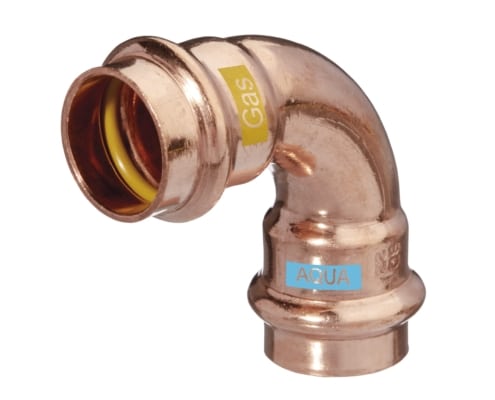
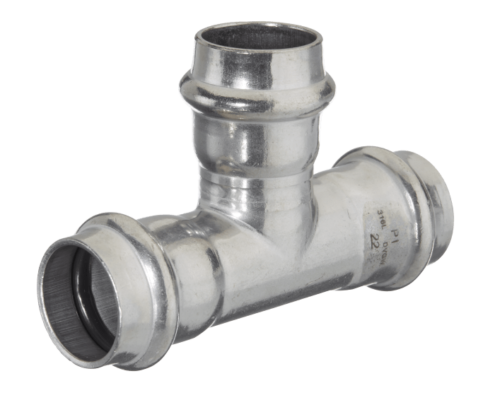
Today, professional heating and plumbing companies work almost exclusively with press fittings. Special pressing tongs or electric pressing machines are used to press copper, steel or multi-layer composite pipes in a single operation. The advantage is the time saving, the disadvantage is that the fittings are relatively expensive.
Fittings with M and V contour
For pressing metal pipes, the press fittings have a visible bead at the sleeve ends, into which an O-ring is inserted from the inside for sealing. After using the radial press, the original circular cross-section is transformed into a hexagonal shape. The durability and quality of the O-ring is crucial for the service life of the entire system. This is why there are different sealing rings for heating, cooling and drinking water systems than for solar systems, gas installations, the transportation of hydrocarbons and pressure lines.
For fittings with an M contour, the bead is located at the outer end of the fitting. During pressing, the bead is compressed on all sides. This pressing process causes the inserted O-ring to deform and to fit snugly against the inserted pipe. To ensure a tensile and torsion-resistant connection between the fitting and pipe, the socket is pressed in at several points around the bead. For fittings with a V-contour, the bead for holding the O-ring is located in front of the end of the fitting. The socket is stamped all the way around at several points in front of and behind the bead using the pressing tool. The pipe pressed in this way is then also resistant to rotation and tension.
Press fittings for PE (polyethylene) and multilayer composite pipes
In order to prevent severe deformation during the pressing process, press fittings for plastic pipes are fitted with support sleeves so that they can be pressed radially.
Threaded fittings
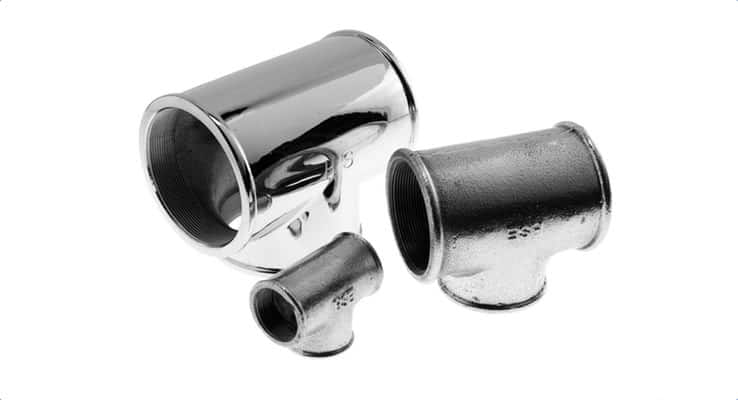
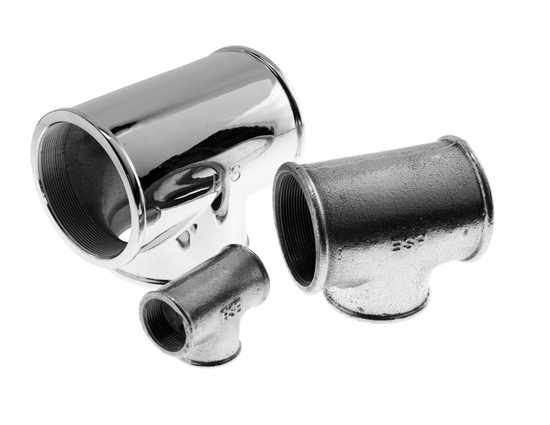
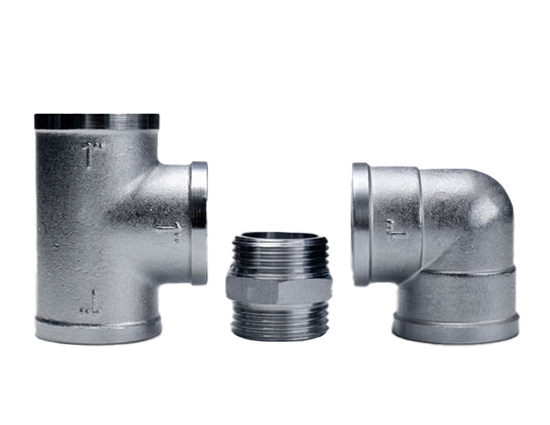
All major companies in Germany have their threaded fittings manufactured in Asia. Pipe nipples, weld-on nipples or blind plugs are imported from the Far East due to the low manufacturing costs. Threaded fittings made of stainless steel are manufactured using the investment casting process. The threaded fittings for the European market comply with the ISO7-1 standard. This means that the thread dimensions comply with the international ISO7/1 standard. DIN EN 10226-3 applies to the new gauge system in accordance with ISO7/1. This pipe thread is designed for a thread-sealing connection.
Weld fittings
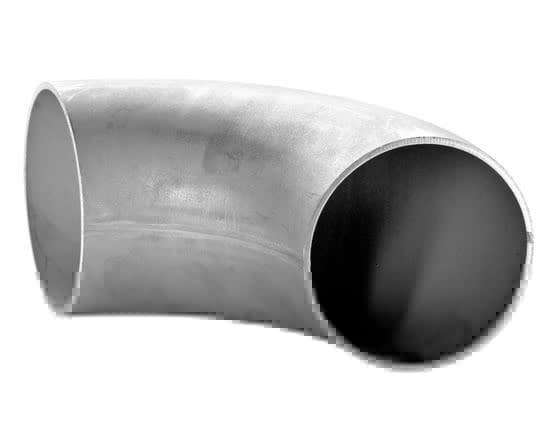
Weld fittings with a polished surface are installed in the food industry in particular in order to comply with hygiene guidelines. These fittings are also standardized and are formed from either seamless or welded stainless steel pipes.
The maximum achievable pressure values of pressfitting systems
The rules for carrying out pressure tests are specified by the DVGW. The press connections can withstand loads of up to 16 bar as standard. The prerequisite for this is a well-maintained pressing tool, perfectly lubricated and free of metallic residues and dirt. The pressure resistance tests are preferably carried out with water, as other liquids, such as oil, could have an influence on the O-ring. Some laboratories wanted to know even more precisely and also measured the burst pressure values (the pressure value at which the correctly crimped fitting detaches from the pipe) for various pipe diameters under the strictest safety controls.
Stainless steel press fitting
Pipe diameter Burst pressure
- 12 mm 200 bar
- 15 mm 170 bar
- 18 mm 130 bar
- 22 mm 170 bar
- 108 mm 50 bar
The measured values show that for all standard applications of a pressfitting system, the guaranteed maximum pressure of 16 bar offers maximum safety and, in the event of a disaster, would have to increase many times over before the pipe system bursts. For heating and sanitary systems in particular, the pressfitting system is a real asset in terms of the time factor and is almost without alternative in times of rising labor costs.